
13 Things You Can Do If Your Child Is Feeling Isolated At School
As a parent, you don't have to feel helpless when your child feels lonely at school.
MAKING FRIENDS
J. C. Larson
1/3/20268 min read

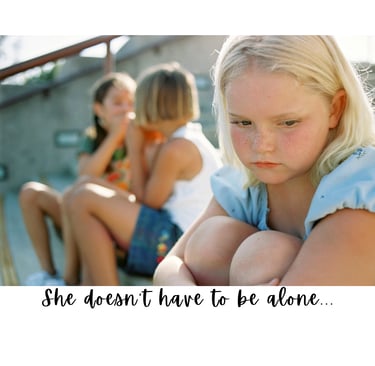
In my book, Cindy's Wolfie Wish, Cindy is new to her school and wants friends. She believes that if she can make the most popular girl at school like her, then everyone else will follow. She makes a plan, gives incredible effort, and is completely rejected.
Your child has had at least one experience like this. If they haven't yet, they will. My fifth grader is going through it right now. He just switched schools (because a teacher was a bully, but that's a story for another day), and now he is dying for friends. He has social anxiety, which affects his ability to engage friends and clouds his perception of whether or not they really are friends.
I have a child at school who wants friends so badly, but his efforts are rejected by his classmates. It seems he is trying too hard. The effects are devastating. With each rejection, his smile becomes smaller, and his willingness to try diminishes.
This article explores five reasons children may become isolated at school and practical things you can do as a parent to help.
Social Anxiety: I'm just too afraid to try...
What is Social Anxiety and how does it cause Isolation
Social anxiety, in its most mild form, is just shyness. Everyone feels it from time to time, but it is manageable and doesn't interfere with happiness overall. Social Anxiety, however, can become a disorder.
The Mayo Clinic defines it this way:
My son has what I would call severe social anxiety. He starts to pace back and forth before bedtime. If you ask him what he is thinking about, it is always school. When I probe deeper, I find that he is imagining the worst kind of interactions all the time. His teacher is going to yell at him. His friends will ignore him and outright say, "Go away!" When he comes home from school, he always has some story of whoa to share. "My friends ignored me." But if you probe deeper, you find that he didn't even try to engage his friends. He is waiting for them to come to him.
It becomes an ugly circle. With every negative interaction, perceived or real, his anxiety grows, and that anxiety prevents him from using positive relationship skills that could better his interactions.
What to Look For
Pacing or other nervous behavior before school or another social event
Purposefully avoiding social get-togethers
Frequent or Excessive worrying about what classmates think
Physical symptoms (headaches or stomachaches) that coincide with social events
What Parents Can Do
Increase Emotional Support
I'll admit this is difficult for me. When my son is pacing or crying before bed, and I'm exhausted, the last thing I want to do is sit with him and work through irrational fears. It takes time, and because they are irrational, you can't logic your way out of them. At these times, I have to make sure I'm in check. Am I too tired or emotional myself? It's okay to step away and calm yourself down before and during your interactions with your child. Just be gentle about it. "I am too worked up myself to help you, so I'm going to take some breaths to feel better, and you can do it with me if you want to." Model putting your hand on your heart, taking a deep breath, and saying, "I can do hard things. They make me stronger." When you are feeling better, and he has watched how you do it, then you can come back and ask him to breathe and think through his emotions. Remember, emotions are not wrong, but the messages they bring sometimes are. Accept the emotions and work through their messages.
Teach Social Coping Skills Gradually
When my son is in a spiral, I can't teach him how to calm down. That teaching needs to be done when he is already calm. Teach it directly with words and practice. Teach through example. And if you are like me, teach when you did it wrong that you are sorry, and you will try to do better next time. They need to see your coping skills in action. Then, when you are in a spiral, and you tell him to breathe, it's a part of him. If he's like my son, he will fight you, but don't continue any conversations until you are both breathing.
Work with your Schools
As a teacher, I love it when a parent tells me, "My son has anxiety around..." and then explains it to me. I'm with your kids more than you are. And more importantly, I am with your kids when they are constantly interacting with other kids. If you tell me what he is afraid of, I can teach, observe, and help directly with the problem. Work with your teachers. They are dying to work with you.
Emotions are not wrong, but the messages they bring sometimes are. Accept the emotions. Work through the messages.
Differences in Personality: That's not my style...
How your personality may lead to isolation
It seems there are a million different books and books out there about personality types, how they differ, and how they clash. The simple reason for that being the case is that our personalities do clash, and we still have to figure out how to work with, live with, and like each other.
One of the latest, most popular books that tackles this subject is Surrounded by Idiots by Thomas Erikson. He divides personalities into a matrix of task vs relationship oriented and introverted vs. extroverted. The entire book is dedicated to how to get along with each type of personality, rather than just calling them all idiots.
I am working with students A and B. A is relationship-oriented and introverted. She wants lots of friends but thrives on the one-on-one connection. B is task-oriented and outgoing. The one close friend A has is sometimes monopolized by B. B does not see a need ot include A in her exciting conversations and is annoyed when A tries to participate, seeing it as her taking the spotlight. A has gone home and shared her pain with her mom, and Mom is beside herself to help.
What Parents Can Do
Encourage your Children to Celebrate what EVERYONE has to Bring to the Table
I wish B would do this. She doesn't include A on impulse because she wants to continue to talk and sees A as an interruption, but if she stopped a beat and let A into the conversation, she would find quite the opposite. A is eager at the outset so she can get in the conversation, but she is actually a very good listener, which is what B wants. If she'd give her a chance, she'd have a wonderful audience.
Create Opportunities for your Child to have Quality Time with their Classmates.
This is difficult for introverted me, but it is worthwhile to become friends with the parents of your classmates. Have get-togethers. It's amazing how close children can be when they are put together in a room with plenty to do and nowhere to escape.
Practice Initiating a Conversation that Shows Genuine Interest
If your child's personality makes it difficult or awkward for them to initiate a conversation (like it is for A), you can role-play. Start doing something that you know your child's peers may do in class or on the playground (like play Legos). Have them practice starting a conversation with you. It can be as easy as, "What are you doing?" but don't let it stop there. Children have a tendency to start talking immediately about themselves. Have them ask one more question that shows they are interested in their peer. ("Wow! Your Lego tower is really tall. How long did it take you?"
Peer Rejection: I don't want to be your friend...
Understanding Peer Rejection
Your children are going to be excluded from peer group activities sometimes. It could be because they are not invited or just ignored. For some children, this is a cue to find someone else to play with. If your child is like mine, it feeds into their belief that they are not worthy or unwanted, and a feeling of isolation. According to this study, children who are rejected by peers are more likely to feel lonely, disconnected, and unsafe in school environments. (Split, van Lier, Onghena, Colpin; PubMed)
There are many reasons peer rejection may happen:
Simple misunderstandings that lead to a spat
A dominant child in the peer group makes a decision that excludes your child
Breakdown in initiating friendship attempts
Existing biases of peers
What Parents Can Do
Validate Their Emotions and Be Supportive
When your child tells you they feel left out, it doesn't serve you or your child to overreact, but it doesn't due to underreact either. Their feelings are real. Acknowledge them and empathize, but also help them to realize this won't last forever, and it doesn't change or reflect their worth.
Do Some Problem-Solving
Have them reenact the rejection with you; explain it to you like they are a camera. Make sure you get enough backstory of what was happening in their surroundings when the rejection happened. I did this with my son and found that when he asked to join in play, his friends were not even looking at him, and it was a loud room. We were able to reason that perhaps his friend just hadn't heard him, and he should try again.
Work on Skills that make and Keep Friends
Is your child giving, supportive, and empathetic? Or when you are honest with yourself, do you see your child being selfish or demanding of their friends? Work with your child on social skills. Let them practice on you and encourage perspective-taking through role-play. It can be fun to pretend to be your child and have them see how it feels every once in a while.
Work with Your Teachers
We see things at school that you do not. If you are concerned or are not sure your child is seeing the entire picture, it's very helpful to get the input of your teacher. Also, we teachers don't see everything unless we are put on alert. Put us on alert. Let us know your concerns. We will monitor, intervene, and report. Your children are very important to us.
Low Self-Esteem: I'm not good enough...
How Low Self-Esteem Contributes to Isolation
Children with low self-esteem often use their imagination against themselves. Their beliefs about themselves create an inner world that is full of rejection that doesn't have to happen in real life to be painful. Having gone through the pain once, it's hard to make themselves relive it in a real-life situation. This article confirms that children with lower self-esteem are more likely to withdraw from social interaction. (Shang, Feng, Yan, Sun; SpringerNatureLink)
What Parents Can Do
Celebrate their strengths with them
Children who have low self-esteem will generally focus on what they believe is inadequate about themselves. Plan activities that celebrate the things they have worked hard at. This can be with a treat, an impromptu dance party (it worked for toilet training), or a journaling session where they are only allowed to write things that they are proud of themselves for doing or grateful to themselves for doing.
Teach Resilience
Celebrate your child's mistakes. Resilience requires mistakes and needs to be seen as a triumphant attempt that we learned from. Have the discussion or give them a reflection journal where they can explore the questions, "What did I learn?" "What will I try next time?" and "How was I brave?" Celebrate the bravery and recognize that being brave means being vulnerable (which doesn't feel brave).
Focus on PRs
When I was on the track team, I was the slowest and clumsiest. I wanted to quit. My coach assured me she wasn't expecting her team to win meets. She was 100% expecting her team to consistently make Personal Records. We won meets. Never because of me. But their victory was mine because I, like them, was consistently making PRs. Your child's self-esteem will improve if they are setting goals, working toward them, and making PRs.
Conclusion
Children who feel socially isolated at school need extra love and support at home. You give that support by seeking understanding without judgment, guiding them through their emotions, and intervening in positive ways. You have more power than you think (though less power than you want).
Remember that whatever you do, when the motivation is love, is not wasted.
Hang in there, Mom. You got this.
*Disclaimer: Please understand that my views expressed here are my own. I am not a healthcare provider. What I share comes from the school of experience and hard knocks. If it's useful, use it. If it's not, we'll keep looking for solutions together.